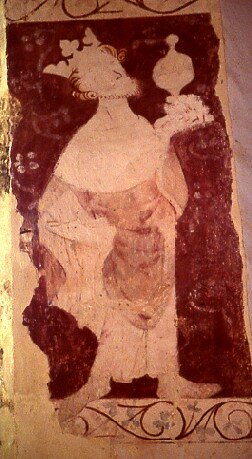
 the righthand splay (photo below right) is a particularly accomplished, stylish piece of work.
Find Burton Dasset on a map
These very fine thirteenth century paintings are in the north chapel at Burton Dassett, on the splays of a window. The painting on the righthand splay (photo below right) is a particularly accomplished, stylish piece of work.
As is normal in this period, the magus is a king; his crown confirms this, and his confident pose befits his regal status. He holds his gift - a covered, chalice-like cup, which might be intended for any of the three traditional gifts of gold, frankincense and myrrh.
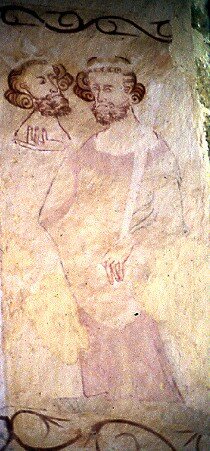
The other two magi, much less clear (this photograph has actually brought out more detail than is apparent to the casual observer in situ) are painted together in the lefthand splay of the window (photo, left). Both of them also have simple circlet crowns, showing now as faint white silhouettes, and the magus on the right holds what seems to be a long whitish staff of some kind, possibly a sceptre, possibly once painted in gold and intended as the first gift, signifying earthly, monarchical authority. The other magus, in the background, has been reduced to head and shoulders only. It is hard to be sure which of these two magi the extended hand belongs to, but the gesture - indicating discussion or argument, is a standard one. I now know what the two Magi are discussing/indicating, and this is followed up on page linked in the paragraph below.
There is other painting in the church, including what I am now certain is a Nativity. There is some faint painting at the west end of the church incorporating what seem to be buildings with oriental domes, but this is still under consideration, and it may be too faint to include here. The Doom above the chancel arch at Burton Dassett is also problematic - a palimpsest with areas of detail dating from different periods. Eve Baker noticed stylistic similarities in it to a Doom at Ashby St. Ledgers in Northamptonshire, which I saw earlier this year, but still need to examine in detail.
Links to other Infancy Scenes
Website for All Saints, Burton Dassett
21/12/2004
© Anne Marshall 2004, 2009 5/3/13